
High concept splat
meh
CRAFT is a reader-supported email newsletter about the nuts and bolts of fiction writing and the world of publishing.
Today I wanted to talk about high concept novels—when they are amazing and when they blow and when they just sort of make us shrug our shoulders. For anyone who needs a review, a high concept book is one that you can pitch with a couple sentences and the premise alone makes people interested in it. For example, The Corrections is not high concept, because while well written, it is about white marital / familial discontent in suburbia. But Clam Down—a memoir about a women turning into a clam—is high concept, actually beyond that a specific subtype of high concept. Lately I’ve been thinking of high concept novels that I wasn’t too wild about and wanted to unpack why.
Allow me to walk you through the below rubric.
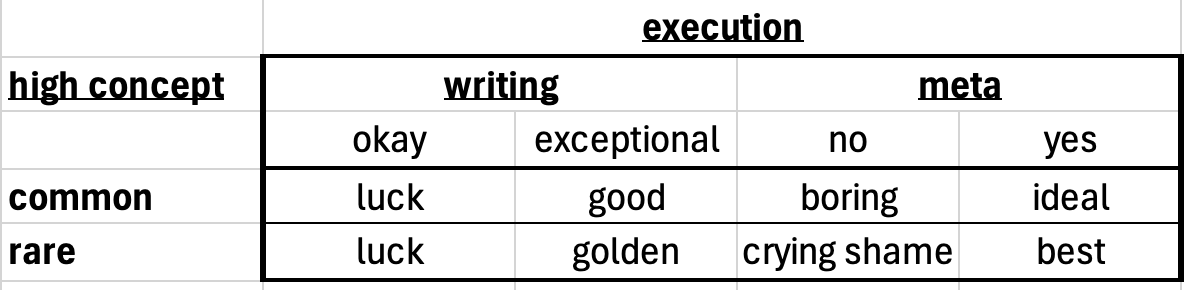
When I think about high concepts, there are high concepts that I would consider “common” and high concepts that I would think of as being “rare.” A common high concept is along the lines of “someone is inevitably going to write a novel about X”—ideally, you would just be the first person to do it. Someone is going to write a Luigi Mangioni romance (if that hasn’t already happened), that is just going to happen. Found footage horror movies have been around since the 90s, so it was inevitable that there would at some point be a found footage x Youtube influencer horror movie (I would at this point classify that as a full subgenre. And one I like!) I would consider my forthcoming book Sugarbaby to be a common high concept. There might be someone who has published a thriller about a sugar baby but at the time when we pitched it, we could only find self-published dark romance novels, and a guide to juvenile diabetes called Sugarbabies: A Holistic Guide to Caring for Your Diabetic Pet. (Since our initial search two years ago, there are now also a few minotaur-related sugar baby romance novels.) Sometimes being the first, or among the first, to land on an editor’s desk with that common high concept is enough to get you a deal. I also think the common high concept idea also gets translated into derivative deals: ie, if publishers are desperately looking for something like Fourth Wing, they may pick up a bunch of derivative works because they are fitting into the high concept of “we need something like Fourth Wing”. (Obviously I think this is lazy and terrible.) So you can be a pretty bad writer who ends up with a book deal for a common high concept if you happen to be at the right place at the right time. You can also be a pretty good writer who ends up with a book deal for a common high concept novel if you happen to be at the right place at the wrong time—I also think if you are a good writer you can make this happen at the slightly wrong place at the slightly wrong time because your talent overrides some of the timing issues.
High concepts are great, but me personally, I am more interested in what I would call a rare high concept, a concept that no one else has come up with, or would come up with. So, Clam Down: I don’t think anyone else would have come up with that because it’s so fucking weird. Surely there are other psychopathic-girl-set-on-revenge novels, but my first book combined that high concept with another high concept: a school for psychopaths where they would be taught to be more well-adjusted people.
Ideally, whether you write a common or rare high concept novel, you would be a good writer, because this just makes it all the easier for someone to give you a book deal. But I think the not-so-great writers don’t see the extent to which they were just first in line and therefore lucky. If you are that person and you happen to strike gold by being first in line with a common high concept.. what do you do for your second book? (I sometimes think that what I just said partially explains for that statistic you sometimes here, that 62% of authors never publish a second book.)
I want to take a brief digression to talk about being an “idea man.” (or “idea person.”) Not everyone is an idea man. I once worked on the same team as this guy Bruno. Our job was, to fictionalize this, to make sandwiches. Some part of this job included an element of “hey, if you could come up with new sandwiches, that would be great.” But the reality was that the press of business was so intense that we just had to churn out sandwiches. My coworker would respond to a request to make a sandwich with an sandwich, as requested. I was also capable of this. Bruno once admitted to me that he was not an “idea guy.” He liked to just be told what direction to go in, and he would execute on that. On the other hand, I’ve always been an “idea guy.” (gal.) I am weird in that I am comparatively very creative within the analytical spaces where I do academic/ political science/ psychology work, and I am weird in creative spaces for the extent to which I am analytical. I describe myself as a methods person, which means that I’m good at coming up with solutions to problems that hadn’t been solved. Social Psychology (which is what my degree is in) is often about “how can we test this thing?” or “how can we measure this thing that can’t be measured?” Methods is about coming up with ways to solve those problems, and it’s what I’m best at. At the sandwich job, I could make BLTs, but also I could invent new sandwiches. I could actually make people rethink what a sandwich even is. [To some extent I am resentful of being asked to make BLTs. Because lots of people can make BLTs.]
The reality is, there is nothing wrong with being a Bruno. Bruno might not come up with a rare high concept, but he could execute a common high concept very well. I don’t know if the average creative goes around wondering the extent to which they are an “idea person.” I think most creatives default to thinking that they are, when in reality, some creative people aren’t really original. If you want to write Harry Potter fanfic, or Fourth Wing comps, that is creative, but it is derivative, so it isn’t really innovative. Some people will bristle at this idea—it’s my take on Harry Potter! Okay, so you put aioli on a BLT. I think these are the same people that have no idea that literally millions of other people out there are also writing novels about professors fucking their students, cancer survival memoirs, or books about star crossed lovers. You can only truly understand the extent to which you are an idea man if you are capable of taking a step back and examining yourself as a person (as Bruno could—he understood that a well-executed BLT was not reinventing the sandwich wheel) and being very aware of what is going on in your genre. You actually can write an excellent novel about a professor fucking their student, but you’d need to do something one step above all over novels about professors fucking their students.
Maybe not shown well in the diagram, but another part of exceptional writing is the extent to which you have meta commentary or understand the thing that you are writing about at a more-than-average level. So whatever the meat of what your high concept is about, to pull this off exceptionally, you have to have really interesting, thoughtful things to say about whatever that concept is. If you are going to touch upon some world, you should have researched it. My second book could be pitched as high concept either on the grounds of what it is about—some kids getting mixed up with a sinister megachurch after witnessing a mass murder—or the meta thing above that, which is that it is an homage to Stephen King’s It. So in order to deliver on that concept, outside of writing good sentences and telling a coherent story there were a variety of tasks I wanted to accomplish: make the readers feel nostalgic, make the readers fall in love with a large cast of characters, make them highly invested in their friendships, induce a feeling of “epicness” based on size and scope and history, include some of the old fashioned sensibility that characterizes King’s writing.
You can write about your high concept and if you are a bad writer at the line level, it will feel like “why did this person get a book deal at all?” If you do your high concept and you’re a pretty good writer, some people might be satisfied with that, but other people will be upset that the meat that was in the sandwich wasn’t all that exceptional. In other words, you didn’t really bring anything interesting to the table about that concept. IMHO, I think this is the heart of the critique about Lindy West’s Adult Braces. I did not think it had an in-depth, intelligent reckoning with the various social issues it brought up: fatness, self-worth, grief, monogamy and polyamory, the intersection of those things and race. Even the road trip itself didn’t have any interesting interrogation of America as a country. I found it odd that with a major fat positivity author, there were two throwaway lines about Wegovy, when the availability of GLP1s is probably something that people who read her fat positivity work a decade ago really would have liked to hear an intelligent take on, one way or another. When you walked away from the book, you did not think “wow, that really made me think about X”—instead the reaction was more “wow, that really made me think about how the author seems oblivious about various things surrounding X.”
Where is the line where someone will say a high concept was executed exceptionally? This is of course, entirely subjective. I think My Dark Vanessa is a book that delivers on its high concept well: it is about a teacher grooming a young female student. The book is well written at the line level, the characters feel realized, and she interrogates all the questions you think she should interrogate. There are people I would recommend that book to, but because I tend to prefer things that are “out there”, I would say there was nothing surprising about that book—it is a very well executed book about that high concept (which is a common high concept.) I devoured Yellowface, that said, I think it’s a perfectly fine book, and it wasn’t quite the scathing takedown of the publishing world that some made it out to be. It was fine, but nothing surprised me [perhaps because I work in publishing,] everything was something that I had heard before. These things are super subjective. A lot of people loved Emma Cline’s The Girls—I think because it is well written at a line level. But I was disappointed in this book, particularly since the premise—a girl joins a Mason-like cult—is an autobuy for me. I am a person who read Helter-Skelter cover to cover when I was like 12. In order for The Girls book to be successful for me, it would have to had a really interesting interrogation of the sort of people who join cults or (ideally, AND) have something interesting to say about America during that particular period of time. I didn’t feel particularly drawn to the main character (who is actually more peripheral to the cult—she is more like the friend of someone who is more centrally located to the cult), and the book was strangely devoid of any sociopolitical commentary about the world that brought us Charles Manson. I mean, the guy wanted to start a race war by killing wealthy celebrities in one of the most turbulent periods of time in America’s history. Nothing to say about that..? okay..
This is just to say: if your book is a high concept book about adopting a kid of another race, have you read a lot about this topic, do you have things to say about it that no one else has said before, could you write an essay entirely about those interesting things independent of a book? The problem is—and you will see it on substack—that there is a lot of unoriginal thinking and it doesn’t appear that the thinkers realize that other people have said those things already. But also you need to do the proverbial work. I’m not going to just write a book about psychopaths and make up a bunch of shit, I’m going to get the 500 page clinical handbook (this is ultimately how/why I ended up being contacted by an actual clinician who works with psychopaths, because the premise of my book alone was enough to make her buy and read it, but then she was surprised that I got stuff right rather than wrong, as she had been expecting. You can see our interview here.) This is yet another reason why, if you come up with a novel idea, you should do some brainstorming and workshopping of that concept with smart people before you start actually writing it. Save yourself time/ trouble.
Random question
I have for some time been mulling the idea of starting a separate Substack, linked to this one covering pop culture, movie/film/TV reviews, personal essays and the like—basically things that don’t fit into Craft because they aren’t strictly about writing or publishing. I would not automatically add anyone who is on this mailing list. Examples of the types of things I would write: longform retrospective on all the Rocky films, a personal essay on the online vilification of avoidant attachment, an in depth consideration of that time on Flavor of Love 2 when a contestant shat on the floor and still didn’t get eliminated. It would not be weekly, but totally sporadic. Anyhow, if this would be something that would interest you, please let me know (anonymously) via this poll.
Book bump
I’m someone who pays close attention to upcoming books, and I wanted to highlight some debuts and one not-so-debut. Note that I have not read these, so I can’t endorse them, but they fell into “premise looks interesting, I will sniff around to hear if it’s good and possibly buy.”

American Hagwon, Min Jin Lee. You already know about my obsession with Pachinko (I just bought the $40 special edition with spredges.) A Korean family is upended from their comfortable lives following a betrayal by a family friend. The thing I am excited about, because she does this so well: “[the characters] struggle to find satisfaction and meaning in a world that seems to grow less forgiving with each passing year.” She manages to do stuff like this without being depressing.
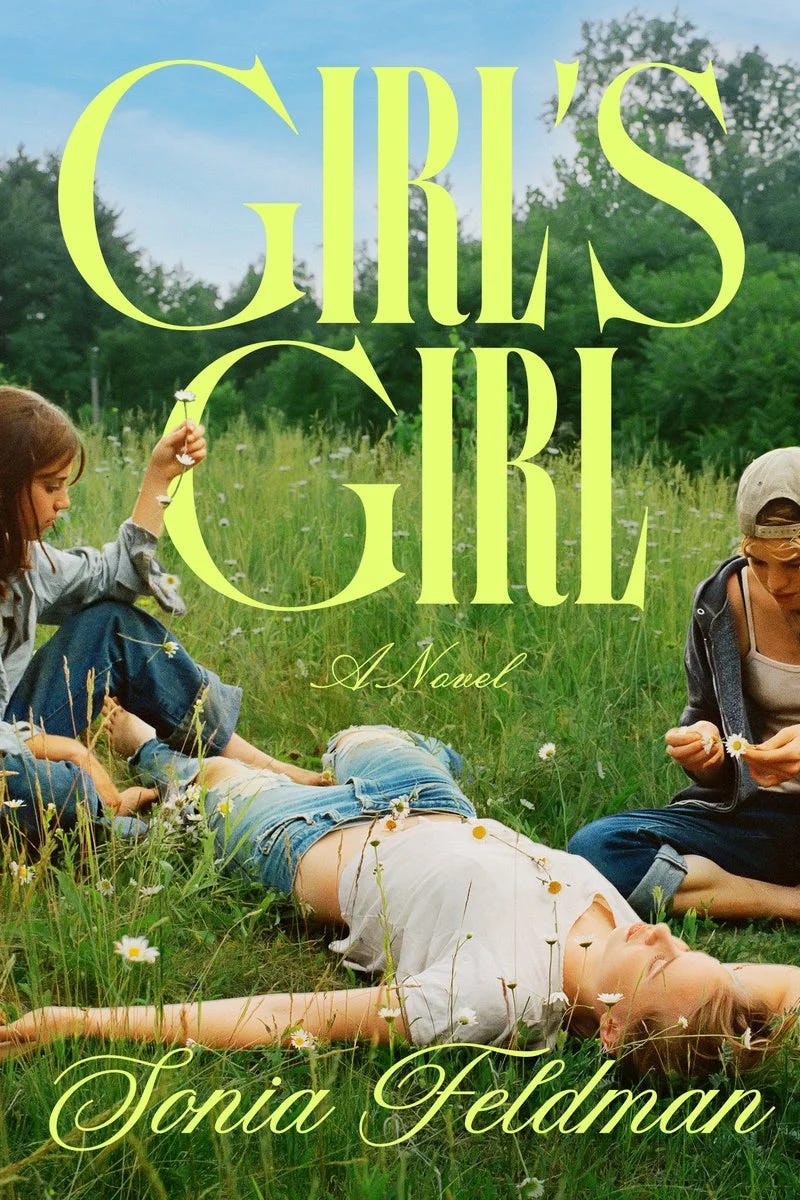
Girl’s Girl, Sonia Feldman. A 15-year old’s friend group of three is shaken one summer when some not-so-platonic feelings and activities arise.

Cat Love, Tomas Q Morin. A novel narrated by Schroedinger’s cat. There! A rare high concept! I absolutely love this cover, although I think they should have used a cuter cat. (I do love the up-chin picture by the O in love — my absolute favorite angle of a cat.) I think I might be emotionally devastated if the cat is not reunited with her former owner, The Mustache.

Kitten, Stacey Yu. A women develops a strange, giddy sense of connection with her boyfriend’s cat. (now THAT is a cute cat on the cover!) I think this might have My Year of Rest and Relaxation vibes.
Photo by Jasmin Egger on Unsplash
I need to start counting my laughs during your pieces.
I appreciate so much the level of research you do for your books and I agree completely with everything here. Now I’m thinking differently about my new project…in a good way! Thank you.